
Tag Archive for: Family

A letter to the lineage that shaped me, and the freedom I choose now.

A Bit About My Father and Me

My dad was born into an affluent family in upstate New York, the son of a corporate executive and inventor in the chemicals industry. He was a star athlete, gifted in intellect, music, and writing. Sharp, charming, and full of potential in the world’s eyes. But instead of following the path laid out for him, he walked away from it all. He left college, turned his back on his family’s inheritance, and chose a different life. One of movement, spirit, and searching.

He met my mom in England, and together they set off for India, where they lived for five years and my sisters were born. Later, they moved to Iran, where I came into the world. From there, we traveled through the Middle East, Europe, and South America. By the time I was 14, I had lived in 16 different countries, spoke multiple languages, and yet always felt like a bit of an outsider though I didn’t realize it back then. It was adventure, and it was also the quiet stress of a family constantly on the move.

I arrived in the United States for the first time at 14, carrying all of those places inside me, still trying to find where I belonged.

I never met my father’s family. He kept his distance from them in a way I still don’t fully understand.

My dad carried strong ideals. He was a true anti-establishment individual, turning his back on the path laid out for him. He rejected the corporate world and the life of capital gains, and fully embraced the spirit of the 60s, travel, freedom, rebellion, the search for something real beyond material success.

He walked away from the world he was born into, and in many ways, I think he carried the weight of that choice for the rest of his life.

And so do I.

For better or for worse.

The constant movement, the never ending travel, and the absence of family roots left something in me, a quiet ache I carried for years without ever really facing. A sense of not fully knowing where I came from, or who I belonged to.
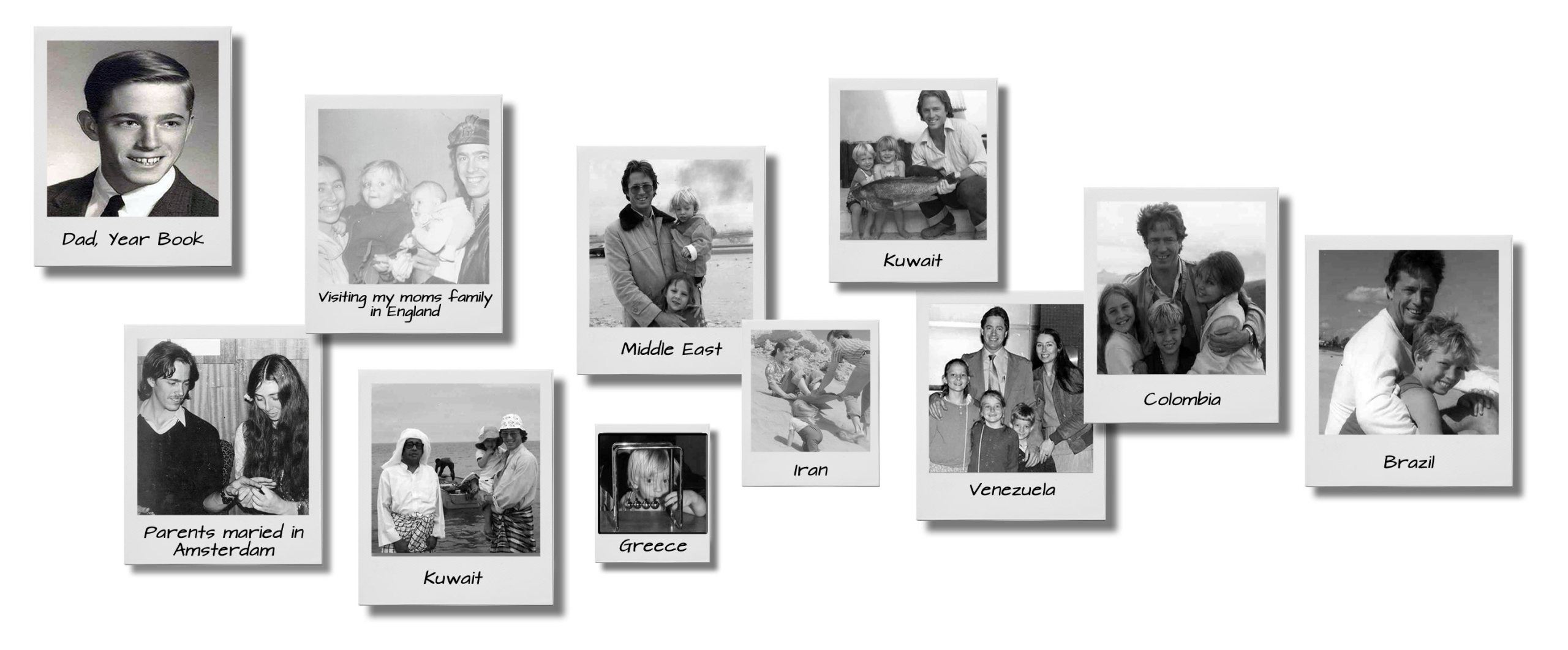
Photos from my life with my father growing up

The Father Wound

For most of my life, I didn’t think I carried a father wound. I thought I had made peace with the way things were. I thought I had outgrown it, moved on, done my work.

But the truth is, I couldn’t see it. I couldn’t see how much of my identity had been shaped by the quiet ache of a disconnect. By the weight of unspoken expectations. By the silent agreements we make as children to carry what was never ours to hold.

Not all of us have fathers we can sit down with, or conversations we get to revisit. But we all carry the opportunity to release ourselves and those who came before us from the cycle of trying to make the past different than it was.

What I’ve come to understand is that forgiveness isn’t about forgetting what happened. It’s about finally accepting what did. It’s about choosing to carry forward only what brings life.

This moment feels like a passage for me. A doorway beyond confusion. A breath of clarity after a lifetime of holding it all in.

I am grateful for the father I chose to be mine in this life. I am grateful for what he could give, and for what he couldn’t.

And so, I offer these words as a way of letting go, and as a way of carrying forward the flame that is now mine to tend.

Letter to My Father


Dad, I see now that you were moving through waves you didn’t always have the tools to name. And I was a boy trying to find safety in a sea of emotions that didn’t belong to me but shaped me all the same.

I know now that your silence wasn’t always indifference. Sometimes it was protection. Sometimes confusion. Sometimes the only way you knew how to survive.

You carried pressure I never fully understood. The weight of responsibility. The demand to plan, to build, to hold it all together even when you were unraveling inside.

I felt that. Not through words, but through presence. Through your absence. Through the way you looked out the window and didn’t return for a while.

And somewhere in all of it, I made a vow to be strong. To be good. To be what I thought you needed.

But I don’t want to carry that anymore. I don’t need to hold the frustration that wasn’t mine. I don’t need to fix the broken pieces of a lineage that never asked me to save it. I don’t need to prove my worth through performance, or silence my truth for connection.

I forgive the ways you couldn’t hold me because I now hold myself.

And more than anything, I honor what you gave, your blood, your effort, your story, even if it came wrapped in struggle.

I choose to take only what is mine now. The strength. The fire. The grit. But I leave the rest in love.

So I can walk free. So I can father myself. So I can father my life, my family, my children.

Thank you for giving me this body. Thank you for giving me your flame.

I carry it now not as a burden, but as a torch.

Love,
Naim

I Didn’t Know How This Would Be Received

Or if I would have a response.

But I did. And it moved me.

“Your raw honest sharing hits me profoundly in my heart and gut. I feel everything you’re saying, maybe more than you know. I’m so sorry I was so wrapped up in myself. You’re very brave and generous and gracious in your understanding, but I don’t deserve the credit you’re giving me. I know now how absent and self-involved I was, and it’s shallow and shameful. ‘The strength, the fire, the grit.’ You’ve shown that your whole life. I’m so very proud of you and love you very much.”


In Closing

Whether your father is in your life or not, whether he can hear you or not, these words can still be spoken. Not for him to fix, or even to reply, but for you to release.

Sometimes the conversation we need to have is not about being heard by them, but about hearing ourselves, finally, fully, and without holding back.

This is my story, but it could just as easily be yours.

May you find the words that set you free.
May you carry forward only what is yours to carry.
And may the rest return to the wind.

With Aloha,
~Naim

Note:
What is the father wound?

The Father Wound refers to the psychological, emotional, or energetic imprint left by the absence, neglect, or emotional unavailability of one’s father or father figure.

It can show up as:

  • Feeling unseen, unworthy, or not enough

  • Overperforming to seek validation

  • Distrust of authority or masculine energy (in self or others)

  • Fear of failure or not measuring up

  • Difficulty receiving support or guidance

  • Carrying unspoken resentment, grief, or longing

The wound isn’t just caused by fathers who were physically absent.
It can come from fathers who were emotionally distant, overly controlling, inconsistent, or unavailable to meet their child’s emotional needs.

It is not about blame, but about recognizing the unconscious impact of that relationship so that we can release the patterns we carry, and begin to heal, forgive, and redefine what healthy masculine presence means—first within ourselves, and then in how we show up for others.

Leadership Begins Within: The Power of Personal Leadership in Community, Family, and Business

Leadership is often framed as the ability to inspire and guide others toward a shared goal. However, true leadership begins from within. Personal leadership — the practice of taking ownership of one’s growth, values, and emotional regulation — lays the foundation for effective leadership across every domain of life, including community, family, and business. Drawing from the insights of Conscious Leadership Group and LifeLabs Learning, this article explores how cultivating personal leadership impacts not just individual development but also the health and success of the systems we are part of.

What is Personal Leadership?

At its core, personal leadership is the ability to lead oneself with self-awareness, accountability, and intentionality. It’s not about positional power but rather about taking full responsibility for your actions, emotions, and mindset. Personal leadership invites you to ask: What do I stand for? How do I show up when no one is looking? Am I in alignment with my values?

Conscious Leadership Group emphasizes the importance of self-awareness and emotional ownership as cornerstones of personal leadership. A conscious leader recognizes their reactive patterns and intentionally shifts to a place of curiosity, responsibility, and presence. LifeLabs Learning adds that personal leadership involves developing meta-skills — such as emotional regulation, feedback-seeking, and strategic thinking — which foster continuous growth and adaptability.

Key Components of Personal Leadership

  1. Self-Awareness:
    The practice of noticing your thoughts, emotions, and behaviors in real-time. Are you reactive or responsive? Are your actions aligned with your values?
  2. Emotional Regulation:
    LifeLabs Learning emphasizes emotional agility as a critical skill. This means being able to pause, observe your emotions, and choose your response, rather than reacting unconsciously.
  3. Intentional Action:
    Conscious leaders focus on intentionality—choosing actions in alignment with their values rather than out of fear or ego. This often involves developing habits like daily reflection, mindfulness, and grounding practices.
  4. Growth Mindset and Feedback:
    Both Conscious Leadership Group and LifeLabs stress the importance of embracing feedback. Leaders must be willing to grow through learning, mistakes, and discomfort, modeling continuous improvement for those around them.

Personal Leadership in Family: Becoming a Pillar of Stability

Leadership within the family starts with leading yourself. A personal leader takes responsibility for their own energy, emotions, and behaviors, modeling what it means to communicate authentically and practice empathy.

  • Creating Emotional Safety: A conscious leader at home fosters psychological safety by validating emotions rather than dismissing them. This builds trust and deepens relationships.
  • Role Modeling Healthy Communication: Family members learn from how leaders handle conflict and express their needs. When a parent or partner demonstrates emotional regulation, it creates a ripple effect.
  • Shared Values and Responsibilities: Just as in business, families thrive when members align on shared values. Personal leadership ensures that each person takes ownership of their role in co-creating a healthy home dynamic.

Personal Leadership in Business: The Foundation for Organizational Success

Businesses thrive when personal leadership is embedded within the company culture. Conscious Leadership Group argues that leadership in organizations begins with taking 100% responsibility — understanding that leaders are accountable not just for their outcomes, but for their mindset and relationships.

  • Adaptive Leadership: Leaders who practice self-awareness are better equipped to handle uncertainty and change, qualities that are essential for modern business environments.
  • Psychological Safety in Teams: LifeLabs Learning points out that teams flourish when individuals feel safe to express ideas and ask questions. Personal leadership fosters this environment by modeling openness and vulnerability.
  • Leading with Values: Leaders who align their personal values with business goals inspire trust and authenticity. This creates a sense of purpose that motivates teams and promotes long-term success.

Personal Leadership in Community: Leading by Example

Communities rely on leaders who embody integrity and compassion. Personal leadership in a community setting means being present, serving others, and taking action that aligns with the common good.

  • Service-Oriented Leadership: True community leaders serve others by addressing needs while inspiring collective responsibility.
  • Strengthening Networks: Leaders in communities build strong connections by fostering trust and belonging. This often involves having difficult conversations and being present during times of both celebration and crisis.
  • Navigating Differences with Curiosity: Conscious Leadership Group emphasizes that leaders should shift from a mindset of judgment to one of curiosity, especially in diverse settings. This openness promotes inclusion and innovation.

The Ripple Effect: Personal Leadership Leads to Collective Well-being

The impact of personal leadership extends beyond the individual. As you cultivate leadership within yourself, you naturally begin to influence those around you — family, colleagues, and community members. The conscious choices you make ripple outward, inspiring others to take ownership of their own growth and contributions.

  • In Business: A leader who practices emotional regulation, intentional action, and values alignment creates a culture of trust and empowerment.
  • In Family: A parent or partner who communicates mindfully and models personal responsibility fosters deeper connection and stability.
  • In Community: A community member who acts with compassion and integrity inspires collective action and nurtures belonging.

Practical Steps to Strengthen Personal Leadership

  1. Daily Reflection: Take time each day to journal or reflect on how you showed up in various roles.
  2. Embrace Feedback: Regularly seek feedback from trusted sources to identify blind spots and growth opportunities.
  3. Practice Emotional Regulation: Use mindfulness or grounding techniques to pause before reacting to emotions.
  4. Clarify Your Values: Identify your core values and align your actions with them.
  5. Build Support Systems: Surround yourself with mentors, friends, and communities that support your growth.

Conclusion: Navigating Life with Purpose and Presence

Personal leadership is about being intentional in how you show up for yourself and others. It involves mastering self-awareness, emotional regulation, and intentional action to create meaningful connections and foster growth. Whether in family, business, or community, the leader who navigates life with presence and purpose becomes a catalyst for collective well-being.

Drawing from the philosophies of Conscious Leadership Group and LifeLabs Learning, it’s clear that leadership starts from within. When you lead yourself well, you pave the way for healthier relationships, thriving communities, and sustainable business success. In the sea of life, you are the navigator — the one who charts the course, adapts to storms, and creates new paths forward with courage and love.