Tag Archive for: Masculine

The word ‘container’ shows up a lot in psychology speak.

Usually it refers to the people and the process that create a safe enough environment for difficult things to be spoken. The idea is that whatever arises can be held, honored, and worked with, without spilling out, without causing further harm through the very act of processing or reconciliation.

That we have the capacity to contain.
To hold.

What strikes me is how practical the word actually is.

A container is simply something that holds, carries, or organizes something else so it can be moved, stored, or protected. Functional. Structural. No mysticism required.

From Latin continēre
con meaning together
tenere meaning to hold, keep, sustain

When life calls me to be the container, I notice confusion arise.

Is this a role?
An identity?
A personality type with good listening skills and calm eyes?
Or is it an action?

But if I merge the psychological use of the word with its practical meaning, something becomes clear.

A container is not what something claims to be.
It is the result of what it actually does.
Or what it did. Past tense.

Proof lives in outcome, not intention.

And that changes things.
A container spills when it’s over capacity. It didn’t contain.

  • How much can I actually hold right now?
  • What is mine to carry?
  • What belongs to someone else’s character arc?
  • Who is pouring?
  • How fast?
  • Do I have the space, the structure, the reserves?

A container fails when it is over capacity.

Not because it is weak, but because it is overloaded.

Too much volume.
Too much force.
Too little margin.

What happens if I move too early, or too late?
If I shake the container at the wrong moment?
If I stay silent too long and pressure builds?
If I shut down and there is nowhere for anything to go?

We like to romanticize emotional strength, but most containment is engineering, not poetry.

  • Intention.
  • Construction.
  • Clear boundaries.
  • Planning for adversity.
  • Realistic expectations.

Not an identity to wear.
An awareness to practice.

A verb, not a noun.

The contain-er.

Air Air

What is Masculine Containment

noun
A man’s capacity to regulate his nervous system and remain present, grounded, and curious under pressure. The ability to hold emotional or energetic intensity without leaking chaos through defensiveness, collapse, dominance, or withdrawal.

Example:
His masculine containment created enough safety for the conversation to soften.

verb
To actively stabilize and lead moments of emotional or energetic intensity through presence and clarity, allowing what arises to be expressed and integrated rather than escalated or suppressed.

Example:
He contained the moment without judgment, guiding it toward understanding and repair.


A letter to the lineage that shaped me, and the freedom I choose now.

A Bit About My Father and Me

My dad was born into an affluent family in upstate New York, the son of a corporate executive and inventor in the chemicals industry. He was a star athlete, gifted in intellect, music, and writing. Sharp, charming, and full of potential in the world’s eyes. But instead of following the path laid out for him, he walked away from it all. He left college, turned his back on his family’s inheritance, and chose a different life. One of movement, spirit, and searching.

He met my mom in England, and together they set off for India, where they lived for five years and my sisters were born. Later, they moved to Iran, where I came into the world. From there, we traveled through the Middle East, Europe, and South America. By the time I was 14, I had lived in 16 different countries, spoke multiple languages, and yet always felt like a bit of an outsider though I didn’t realize it back then. It was adventure, and it was also the quiet stress of a family constantly on the move.

I arrived in the United States for the first time at 14, carrying all of those places inside me, still trying to find where I belonged.

I never met my father’s family. He kept his distance from them in a way I still don’t fully understand.

My dad carried strong ideals. He was a true anti-establishment individual, turning his back on the path laid out for him. He rejected the corporate world and the life of capital gains, and fully embraced the spirit of the 60s, travel, freedom, rebellion, the search for something real beyond material success.

He walked away from the world he was born into, and in many ways, I think he carried the weight of that choice for the rest of his life.

And so do I.

For better or for worse.

The constant movement, the never ending travel, and the absence of family roots left something in me, a quiet ache I carried for years without ever really facing. A sense of not fully knowing where I came from, or who I belonged to.
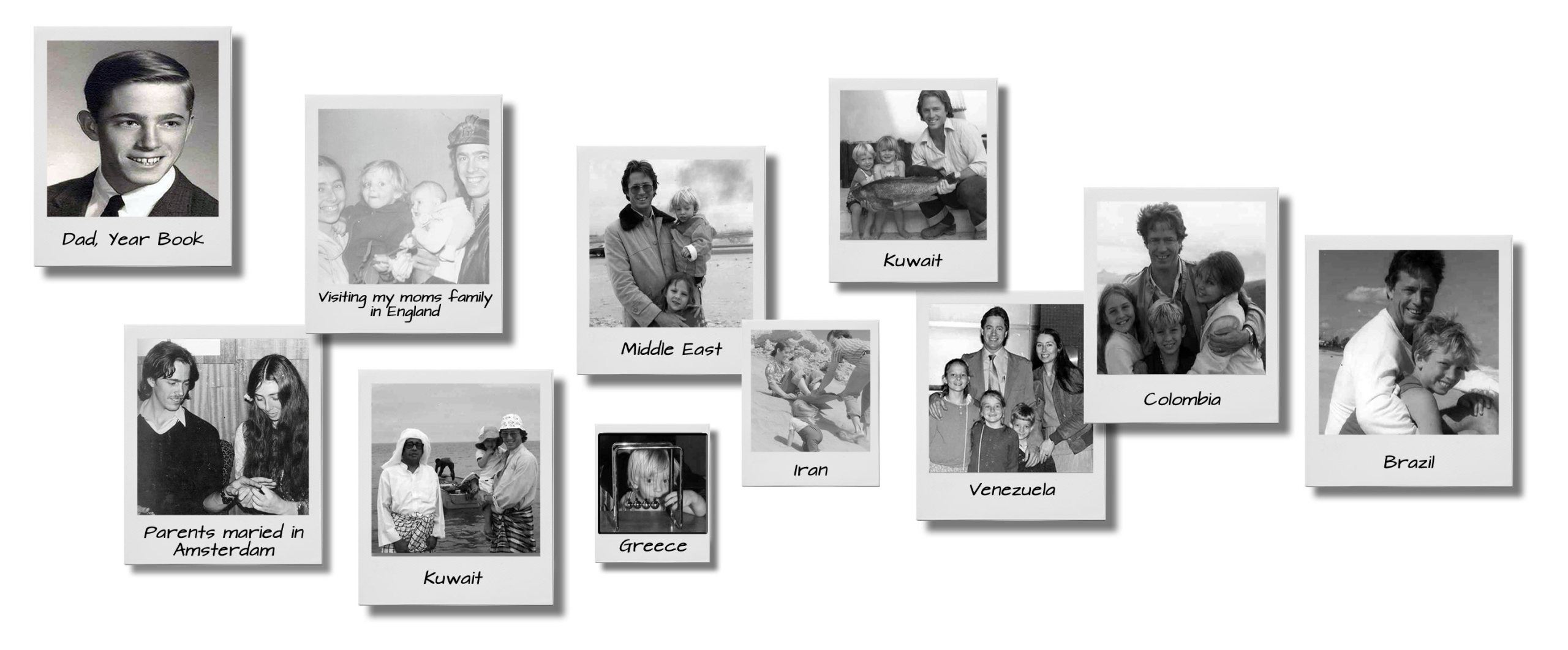
Photos from my life with my father growing up

The Father Wound

For most of my life, I didn’t think I carried a father wound. I thought I had made peace with the way things were. I thought I had outgrown it, moved on, done my work.

But the truth is, I couldn’t see it. I couldn’t see how much of my identity had been shaped by the quiet ache of a disconnect. By the weight of unspoken expectations. By the silent agreements we make as children to carry what was never ours to hold.

Not all of us have fathers we can sit down with, or conversations we get to revisit. But we all carry the opportunity to release ourselves and those who came before us from the cycle of trying to make the past different than it was.

What I’ve come to understand is that forgiveness isn’t about forgetting what happened. It’s about finally accepting what did. It’s about choosing to carry forward only what brings life.

This moment feels like a passage for me. A doorway beyond confusion. A breath of clarity after a lifetime of holding it all in.

I am grateful for the father I chose to be mine in this life. I am grateful for what he could give, and for what he couldn’t.

And so, I offer these words as a way of letting go, and as a way of carrying forward the flame that is now mine to tend.

Letter to My Father


Dad, I see now that you were moving through waves you didn’t always have the tools to name. And I was a boy trying to find safety in a sea of emotions that didn’t belong to me but shaped me all the same.

I know now that your silence wasn’t always indifference. Sometimes it was protection. Sometimes confusion. Sometimes the only way you knew how to survive.

You carried pressure I never fully understood. The weight of responsibility. The demand to plan, to build, to hold it all together even when you were unraveling inside.

I felt that. Not through words, but through presence. Through your absence. Through the way you looked out the window and didn’t return for a while.

And somewhere in all of it, I made a vow to be strong. To be good. To be what I thought you needed.

But I don’t want to carry that anymore. I don’t need to hold the frustration that wasn’t mine. I don’t need to fix the broken pieces of a lineage that never asked me to save it. I don’t need to prove my worth through performance, or silence my truth for connection.

I forgive the ways you couldn’t hold me because I now hold myself.

And more than anything, I honor what you gave, your blood, your effort, your story, even if it came wrapped in struggle.

I choose to take only what is mine now. The strength. The fire. The grit. But I leave the rest in love.

So I can walk free. So I can father myself. So I can father my life, my family, my children.

Thank you for giving me this body. Thank you for giving me your flame.

I carry it now not as a burden, but as a torch.

Love,
Naim

I Didn’t Know How This Would Be Received

Or if I would have a response.

But I did. And it moved me.

“Your raw honest sharing hits me profoundly in my heart and gut. I feel everything you’re saying, maybe more than you know. I’m so sorry I was so wrapped up in myself. You’re very brave and generous and gracious in your understanding, but I don’t deserve the credit you’re giving me. I know now how absent and self-involved I was, and it’s shallow and shameful. ‘The strength, the fire, the grit.’ You’ve shown that your whole life. I’m so very proud of you and love you very much.”


In Closing

Whether your father is in your life or not, whether he can hear you or not, these words can still be spoken. Not for him to fix, or even to reply, but for you to release.

Sometimes the conversation we need to have is not about being heard by them, but about hearing ourselves, finally, fully, and without holding back.

This is my story, but it could just as easily be yours.

May you find the words that set you free.
May you carry forward only what is yours to carry.
And may the rest return to the wind.

With Aloha,
~Naim

Note:
What is the father wound?

The Father Wound refers to the psychological, emotional, or energetic imprint left by the absence, neglect, or emotional unavailability of one’s father or father figure.

It can show up as:

  • Feeling unseen, unworthy, or not enough

  • Overperforming to seek validation

  • Distrust of authority or masculine energy (in self or others)

  • Fear of failure or not measuring up

  • Difficulty receiving support or guidance

  • Carrying unspoken resentment, grief, or longing

The wound isn’t just caused by fathers who were physically absent.
It can come from fathers who were emotionally distant, overly controlling, inconsistent, or unavailable to meet their child’s emotional needs.

It is not about blame, but about recognizing the unconscious impact of that relationship so that we can release the patterns we carry, and begin to heal, forgive, and redefine what healthy masculine presence means—first within ourselves, and then in how we show up for others.


I’m sharing a little bit of my personal journey.

Lately, I’ve been writing a lot, there’s a lot moving in me during this threshold season of my life. I hope to share more of what’s coming through, but for now, what feels alive is the practice itself. The steps. The commitment. The ceremony.

Last night, I sat with my men’s group around the fire, as we’ve done for the past five years.
In that circle, I offered a simple ceremony, reading a letter to name what I’m leaving behind, and placing a log on the fire to mark it.

A small gesture, but it felt like a turning point.

A way of honoring what’s dying, and what’s ready to emerge.

A condensed version I share with you here:

Brothers,

I want to name what’s happening in me, around me, and through me right now

Something is dying. Not in a tragic way, but in a sacred, necessary, and irreversible way

I am not in crisis.
I am in crossing

This is not about a single moment or mistake. It is about old identities that once protected me and now no longer serve the man I am becoming

I see the pleaser, the one who tried to stay good and safe to avoid conflict
I love him. But I am not negotiating with my truth anymore

I see the rescuer, the one who needed to fix others to feel needed
I am learning love is presence, not rescue

I see the self-abandoner, the one who left his own body to stay connected
He is tired. I am here to hold him now

I see the performer, the one who polished the outside but sometimes hid the raw inside
I am letting go of needing to be perceived as anything other than real

I see the philosopher of pain, the one who talked about emotions to avoid feeling them
Now I let the wave come. I stay

I see the sexual escapist, the one who sought intensity over intimacy
I am choosing sacred, devotional union

I see the isolated warrior, the one who carried it all alone
I am choosing brotherhood now

I see the contorted leader, the one who led from urgency and survival
I am remembering leadership is stewardship, not proving

I see the child of chaos, the boy who thought pain meant love
I am building a home of stillness

This is the threshold I am walking through

It is tender
It is humbling
And it is sacred

I do not need to be rescued
But I do want to be witnessed
Held
Reflected
Supported

I am choosing to walk with more integrity
More rootedness
More grace

And if you see me drifting back into what is dying
Remind me
Not by correcting me
But by holding the frequency of who I truly am

Thank you for listening
Thank you for standing with me
And to the parts of me that are dying—thank you for getting me here
You can rest now
I have got it from here

I walk through the gate
I do not look back
I become

With aloha
~Naim

A Journal; Considering Death, Life, and the Dance with the Feminine

Resurrection, or anastasis, is the concept of coming back to life after death.

In some spiritual traditions, it refers to the return of a soul into the same body. In others, like reincarnation, it points to the reentry of the soul into a different form.

But resurrection, in its truest sense, is not just about a body rising from a tomb.

Resurrection is the reanimation of our being.
It is the return of consciousness to a body that has gone numb.
It is spirit returning to a vessel that has forgotten its purpose.
It is the self coming alive again, after we have surrendered what is no longer true.

We move through endings, unravelings, grief portals. We lose people, roles, illusions. We die into stillness, the unknown, not knowing what comes next.

And when the death is complete, when we’ve laid down the armor of pain and the outdated self, we don’t resurrect by willpower. We resurrect when something else enters the room.

Where Did She Go?

Magdalene
We’ve been taught resurrection is a solo act. A story of a man, a cave, a miracle.

But if you listen deeper, beneath the Western myth, there is a hole in the legend.

  • Osiris was reassembled by Isis.
  • Dumuzi was pulled from the underworld by Inanna.
  • Jesus, if the myth were whole, would have been resurrected by Mary Magdalene, his Beloved, his Priestess, his mirror.

Where did she go in the modern retelling?

Why was she written out of the miracle?

The men fled. The women remained. They grieved. They witnessed. They sang to the bones. They kept vigil.

Resurrection is not a masculine achievement.
It is a feminine initiation.

It is not self-willed revival. It is the return of the Beloved..within and without.
The woman by your side, the mother who gave you life, the daughter that you raise, and devine femine architype within you wanting to seen and realized.

A Glimpse from My Own Resurrection, A Death Portal experience, witnessing my own demise

Life and death reflections
In my own life, I’ve been walking through a death of identity, quiet but devastating, in at every aspect of my life, love, family, career and even life itself have been power cycled.

The past two years unearthed childhood wounds. My mother had a stroke that left her permanently changed. It tore open grief I wasn’t ready to meet. I blacked out in the ocean in big surf almost 2 years ago, it changed me and led me to quit my career path, leaving my company of 10 years and responding to the Lahaina fires aftermath in search for meaning and calling.

I also experienced painful relational endings, in friendships and romance, mirrors of the boy in me who never felt fully safe. Each breakup and ending became a doorway into deeper intimacy with my shadow self, my patterns and beliefs shaped by fear of more pain.

And now, I find myself in a loving container… yet facing deeper layers.

Love, real love, will confront everything that is not aligned with truth. And here I am.

This relationship has become a crucible. A mirror. A death ground of past wounds.

It has asked me to surrender the fixer, the performer, the hero, the boy who hoped love would heal him, based on his effort, his hard work, his dedication. Without fully doing the work himself and sourcing love from the inside out.

I’m learning to show up not as the rescuer, not as the victim, but as a presence. A listener. The experience itself, without the identity. My aim now is to tune, to the music of life that lives in each moment, each interaction, every step.

And in this, my inner Feminine, Magdalene awakens.

This Is the Work

Resurrection is not a rise to perfection. It is a return to presence.

To stillness. To center. To the truth. To self without the story, the identity, Akua within you, the creator.

And if we are to rise, we must ask:

Where did She go?

We must call Her back.

The women.
The sacred.
The parts of us that still know how to grieve, to listen, and to love without needing to win, protect, or blame.

I cannot resurrect myself alone, not by will, not by force.
But I can choose to become available when the call comes. To enter the tomb and discover it is a womb. The Feminine speaks in a different language. Her truth moves like water, quiet, subtle, undeniable.

When Her song reaches my bones and my heart hints a smile,
I stand at the threshold of resurrection.
New life stirs in the body I thought was too tired to go on.
A new identity begins to emerge, carrying the quiet hope that I might live differently this time: from a higher place, with deeper love, compassion, and devotion.

I remember now that I have the capacity within me
to surf this reality and co-create the love, the family, the community
that brings forth a more beautiful world in harmony with Life.

~NaimNaim and Jessica Maui
In devotion and deep reverence to my partner Jessica Rose and her ability to rise to meet me in light and shadow, in the deaths and rebirths, thank you!

The Ten Shifts: From Wounded to Integrated Self

These are the signposts on my return. Not rules, reminders.
> You can also see these as ways to identify where the wound is in control, and how to shift from wound into a window of wisdom.

  1. The wounded self blames others for what he feels, or blames himself in shame.

    ⌘
    The integrated self owns his inner weather, speaks from center, and shows compassion for where he lost his way. He is at the helm of perspective, the overseer, the high watch, witnessing his parts without them taking over.

  2. The wounded self avoids hard truths.

    ⌘
    The integrated self walks into discomfort with discernment, with care and clarity, holding the experience and allowing the feelings to be felt at each step. Making space for the emotional wave, holding neutrality as an energy to find ‘what is true, what is love’

  3. The wounded self demands to be met.

    ⌘
    The integrated self names his needs and honors his partner’s pace, timing, and energy. Speaking the need, in nuetrality. If needed, taking space alone to honor his needs and meet himself with himself.
    There is nothing wrong with wanting to be met, just don’t demand it. When wanting to be met, he creates the invitation, tunes to the need, finds the time, right energy and words to speak what is true.

  4. The wounded self hears feedback as an attack and defends or attacks back.

    ⌘
    The integrated self listens for the mirror and breathes before reacting. If there is a tingle of charge, something is there for you, if you spot it you got it. If something is off, speak to it after you have time to reflect. “I’m not 100% for what’s true in this, but Ill look.”

  5. The wounded self clings to control to feel safe.

    ⌘
    The integrated self creates safety through presence, not power. The integrated self can see through the strategy of control as what it truely is, an inner child who is not safe and looking for others to create the safety it craves.
    Instead he creates that safety himself. Through meditation, journals, ownership, feeling through. Asking himself “what am I trying to control that cannot be controlled?”

  6. The wounded self hands his emotions to his partner without reflection or awareness.


    ⌘
    The integrated self carries the medicine of self-regulation and awareness. Knowing that his emotions are not hers to hold or soothe. If vulnerability and clearing is needed, he makes the right space for that, to be sure she is ready to meet him. He seeks elders or professional support (3rd party) to ensure she has the capacity. 

  7. The wounded self manipulates from fear of rejection.

    ⌘
    The integrated self reveals desire & direction, making it clear and clean. He welcomes ‘no’ with grace and honors the sovereignty of his partner. He knows that manipulation is not obvious, it masquerades as ‘leadership’ or ‘boundaries’ and thus he knows he has to see himself clearly, and to see what energy is driving his choices, directions.

  8. The wounded self shuts down or explodes when triggered.

    ⌘
    The integrated self pauses, feels, and chooses a response over a reaction. From still point, seeks the opening. Feeling feelings all the way to completion to find the gifts of guidance. 

  9. The wounded self needs constant reflection to feel whole. Seeks soothing or validation from others.

    ⌘
    The integrated self remembers his worth is not up for debate. It is his birthright. Anything that says otherwise is a virus that requires eradication, the old story of giving power away. Eradicate it with love, knowing that Love is who you truly are.

  10. The wounded self waits for love to complete him.

    ⌘
    The integrated self becomes the source and meets love whole. Knowing everything on the outside of self is a reflection of what is within, what has been excavated through the process of remembering his truth. This is the big one, this one is hard to see for most of us. It requires coming back to, daily practice.